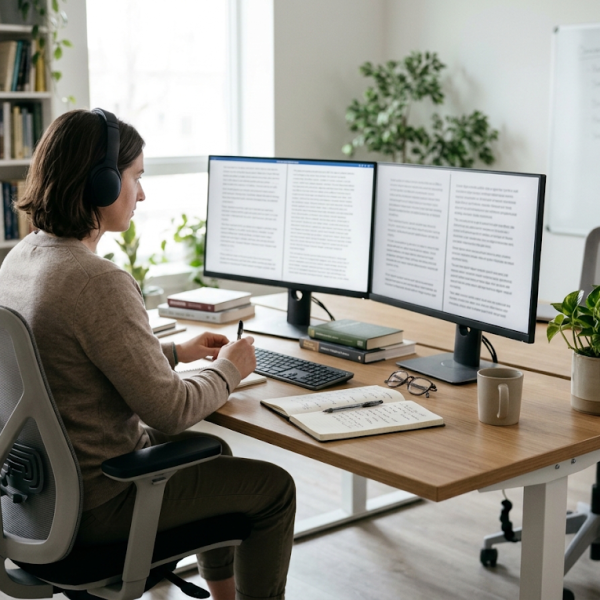
Machine translation has improved so much that many people wonder whether professional translators are still needed. For short, informal messages, the answer may be no. For contracts, medical texts or marketing campaigns, the answer is still a firm yes. Between those two extremes lies a growing practice called post editing, in which a trained linguist corrects and polishes a machine draft. Used well, it saves time and money. Used badly, it produces text that is cheaper but not good enough. Post editing makes sense when the content is repetitive, the quality target is clear and the editor has the skill to decide what to keep and what to rewrite. This article explains how it works, when to choose it and how to avoid its most common problems.
What Post Editing Means
In post editing, software produces a first version of the translation, and a human reviews it. The editor checks meaning, fixes errors, adjusts terminology and improves style. Two levels are usually described. Light post editing aims for an understandable and accurate text, without polishing every sentence. Full post editing aims for a quality comparable to a human translation, with natural style and correct terminology. The international standard ISO 18587 describes requirements for the process and for the people who carry it out, which helps clients to ask for the right service.
Where It Works Well
Machine drafts perform best on structured, repetitive content with clear sentences. Technical manuals, product catalogues, support articles, internal documents and user reviews are typical examples. Engines can be trained on a company's own previous translations, which improves consistency. In these cases, a skilled editor can work much faster than a translator who starts from a blank page. The saving is greatest when volumes are high and deadlines are short, since it allows teams to handle more content without losing control of quality.
Where It Does Not Work
Creative and high stakes texts are poor candidates. Advertising copy, literature, speeches and legal contracts depend on tone, nuance and exact wording, and a machine draft can mislead the editor by sounding fluent while being wrong. Medical and safety documents carry risks that cannot be left to a quick review. Texts with many cultural references, humour or ambiguity also resist automation. In such cases it is usually better to start with a human translator, who can think about the audience and the purpose before writing a single sentence.
Typical Machine Errors
Machines make mistakes that look different from human ones. They may omit a negation, mix up names, mistranslate numbers, use the wrong term for a specialised concept or produce an elegant sentence that says something unrelated. Fluent errors are the most dangerous because they are easy to miss. To see examples of what goes wrong, read this overview of why machines still make mistakes in a real language pair. Editors learn to check each sentence against the source, and not to trust a smooth surface.
The Skills of a Good Post Editor
Post editing is not an easy shortcut. The editor must read the source carefully, know the subject and decide quickly whether a sentence needs a small fix or a complete rewrite. Discipline is important, because over editing wastes time and under editing leaves errors. Good editors also provide feedback on recurring problems, which helps the engine and the glossary improve. For German content, a team that offers german translation services can combine automated drafts with careful human review, adjusting compound words, formal address and technical terminology as needed.
Pricing and Productivity
Because the machine does part of the work, post editing is usually priced below full translation, but the discount depends on the quality of the draft and the target level. Beware of promises that are too good. A poor draft takes as long to repair as to translate from scratch, and a rushed edit can cost more in later corrections. Ask for a small pilot project, measure the time spent, the number of errors found and the satisfaction of readers, and then decide whether the method suits your content.
Data Protection and Tools
Before using any machine engine, check where the text is processed and stored. Public tools may keep or reuse the data that you submit, which is a risk for confidential material. Enterprise systems allow stricter controls. Make sure that your provider explains which technology it uses and how information is protected. Integrate glossaries and translation memories so that approved terms appear in the draft, and update them with every project so that the system learns from corrections.
Setting Clear Quality Goals
The most important step is to define what good means before the work begins. Who will read the text, how will it be used and what level of polish is needed? Document the answers in a short brief and share it with the editors. Review a sample, give feedback and adjust the process. With clear goals, suitable content and skilled people, post editing can be a useful tool in a modern language workflow, one that adds speed without giving up the accuracy that readers expect.